




This section covers all areas of interest for a potential investor/client looking to set up in Bangladesh. The information provided is brief in nature and it is advised that you get in touch with us for more detailed/specific advice.
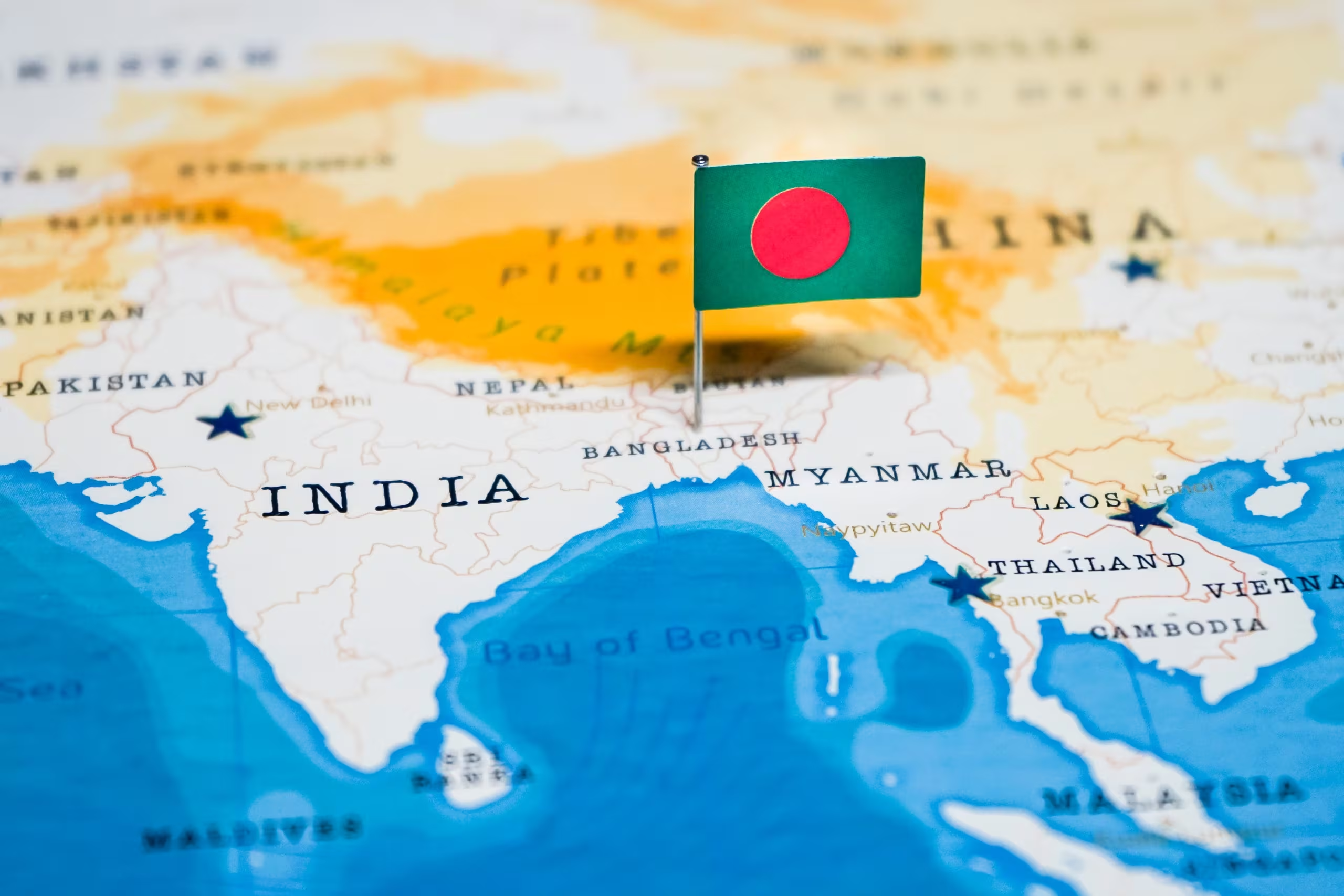
Bangladesh, a country in South Asia, covers an area of approximately 144,000 square kilometres. This area can be divided into two distinct regions: a broad deltaic plain and a smaller hilly region. Bangladesh is bordered by India to the west, north, and east, and by Myanmar to the southeast. To the south, it has an irregular deltaic coastline of about 580 kilometres along the Bay of Bengal. The borders of present-day Bangladesh were established during the British partition of Bengal and India in 1947, when the region became East Pakistan, as part of Pakistan. Due to a desire for political, economic, and linguistic self-determination, popular agitation and civil disobedience grew against the Pakistani state. Bangladesh gained independence following the Bangladesh Liberation War of 1971.
As of 2024, Bangladesh’s population is estimated to be approximately 174.7 million people, making it the 8th most populous country in the world. The population density stands at around 1,342 people per square kilometre. This marks a slight increase from previous years, reflecting a steady growth rate of about 0.99% annually.
Bangladesh continues to have a largely homogenous population, with approximately 98.5% of the population being of the Bengali ethno-linguistic group. The median age in the country is now 27 years, indicating a young population. The majority of the population, around 89%, adheres to Islam, while about 10% follow Hinduism.
The literacy rate has improved significantly over the years, with about 94% of adults being literate. This includes 93% literacy among males and 96% among females.
Bangladesh continues to be one of the fastest-growing economies in the world, progressing towards its graduation from a Least Developed Country (LDC) to a middle-income country by 2026.
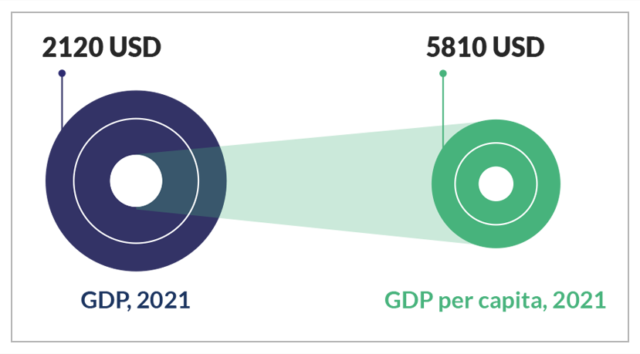
Bangladesh’s economy expanded by 5.5% in the fiscal year 2023 and is projected to grow by 6.5% in 2024, as reported by the IMF. The GDP for 2023 was approximately USD 446.35 billion, showing significant growth from previous years. The GDP per capita stood at around USD 2,790, while the GDP (PPP) per capita was about USD 7,000. The IMF ranked Bangladesh 41st in the world by GDP.
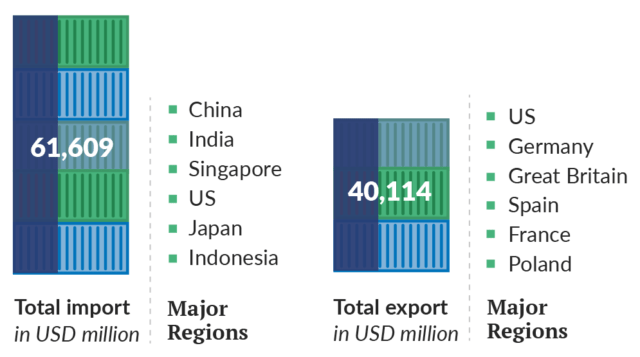
The total amount of exports was USD 55,558.77 million as of 2022-23 (BB). The export scenario is dominated by RMG, with around 85% share (BGMEA). Major exporting regions for RMG products were Europe (Germany, Spain, Italy, France), the US, and Canada. Pharmaceuticals remain promising because of the existing capacity to meet the global demand in generic drugs and the TRIPS exemption, which the country will enjoy for a few more years. Bangladesh has exported to more than 127 countries.
Bangladesh had a total import of USD 68,234.40 million as of 2022-23 (BB). Major commodities imported were cotton, sugar, refined petroleum, palm oil, wheat, and machines. According to Bangladesh Bank, major import regions in 2022-2023 were China (25.3%), India (16.9%), Singapore (4.8%), USA (4.4%), Japan (3.9%), and Indonesia (3.6%)
As of 2023-24, the total remittance inflow for Bangladesh was USD 23 billion. The major countries contributing to this remittance were Saudi Arabia (22%), USA (16%), UAE (12%), UK (10%), Malaysia (8%), Kuwait (6%), and Oman (5%). Remittance remains a significant source of earnings for Bangladesh and continues to hold a prominent position globally
Bangladesh has shown improvements in electrification rate and is currently providing electricity to 100% of the population (Dhaka Tribune). In 2024, the country produced a record high amount of electricity at 15,000 MW. Daily load shedding has dropped to almost 0% from July 2021 to June 2023 (CPD). Despite high levels of improvement in access to water supply across the country, the quality of the water supplied remains substandard. The trend, however, according to the Global Competitiveness Report, shows improvement, with the score increasing from 2.9 out of 7 in 2017 to 3.1 in 2019.
Bangladesh has undertaken multiple infrastructure projects to improve the situation. Significant projects nearing completion include the Padma Bridge Rail Link, the Dhaka Elevated Expressway, the Bangabandhu Sheikh Mujibur Rahman Tunnel, and the third terminal of Hazrat Shahjalal International Airport (Press Xpress). Other ongoing projects include the Chattogram-Cox’s Bazar Rail line, Rampal Power Project, Matarbari Coal Power Plant, and Rooppur Nuclear Power Plant (South Asia Monitor). These projects are expected to enhance connectivity and economic growth significantly
The Bangladesh government is committed to keeping the fiscal deficit below 5% of GDP and has so far been successful (IMF). The total central government’s debt levels were at 41.4% of GDP in 2021 and 42.5% in 2022. As of 2023, the debt level remained sustainable at 35% of GDP. Bangladesh remains at low risk of debt distress with public and publicly guaranteed external debt at about 15% of GDP, and external debt at 12.15% of GDP. Foreign reserve levels were maintained at USD 33 billion. The current account deficit has generally been low, averaging 0.086% of GDP over the past five years. According to the IMF, over the medium term, the CAD will remain broadly stable at around 2% of GDP with lower remittances to GDP, imports of capital, and imports of liquefied natural gas counteracting strong export performance
A private limited company is the most common form of business entity for foreign investors.
Other than that, they can setup branch or liaison offices.
Maximum Shareholders: 50
Minimum Shareholders: 2
Private limited companies must register with:
Branch/liaison offices must register with:
| # | Procedure | Comments | |
|---|---|---|---|
| 1. | Obtain Name Clearance | The proposed name of the company must be cleared from the RJSC. Certain words in a name are restricted and require prior approval such as “bank”, “investments”, “telecommunication” etc. Name clearance is valid for 30 days during which company must be incorporated or extension sought. | |
| 2. | Address | A valid “commercial address” must be provided as a registered address. A commercial address is a purchased or rented space in a building which has commercial approval. Virtual offices are allowed. | |
| 3. | Decide shareholders | If institution, the following information/documents will be required: | If individual: |
|
| ||
| 4. | Decide authorized and paid up capital | No minimum paid up or authorized capital requirement. Investors are free to choose their desired authorized capital limit and paid up capital amounts and the government fees payable on incorporation will be calculated accordingly. | |
| 5. | Form IX –Consent to Act as Director | The first directors must be decided at the time of incorporation through this form. | |
| 6. | Form XII –Particulars of Directors | Director particulars need to be provided in this form, specifically:
| |
| 7. | Opening of bank account | A bank account must be opened with any scheduled bank in Bangladesh. At this point in time this account can only be used for remittance of paid up capital. Documents to be submitted:
| |
| 8. | Remittance of paid up capital | Each shareholder must remit exact or more than the amount of paid up capital he/she is subscribing for in Bangladesh Taka to above bank account opened in name of the Company. | |
| 9. | Obtain encashment certificate | Bank will provide encashment certificate as proof of remittance of paid up capital | |
| 10. | Filing with the Registrar of Joint Stock Companies & Firms for incorporation | ||
| # | Procedure | Required Info/Documents |
|---|---|---|
| 1. | Prescribed application form duly filled in | |
| 2. | Proposed organizational set-up | |
| 3. | Details of activities performed through the proposed office in Bangladesh | |
| 4. | Registered Address | A valid “commercial address” must be provided as a registered address. A commercial address is a purchased or rented space in a building which has commercial approval. |
| 5. | Necessary submission from parent company |
|
Aforementioned documents will be submitted to BIDA along with the application for incorporation. BIDA’s permission for setting up a BO/LO will include a condition to remit at least USD 50,000 to the BO/LO’s Bank account from Parent within 2 (two) months as establishment cost and operational expenses for six months. Failing to remit the amount within the deadline will result in the company having to remit 5% (five percent) additional amount for each month.
| Name | Comments | Required Info/Documents |
|---|---|---|
| Electronic Tax Identification Number (e-TIN) | All entities are required to register with the National Board of Revenue and obtain a TIN number. |
|
| VAT/BIN Registration | All entities are required to register with the National Board of Revenue and obtain a BIN number/VAT Registration. |
|
| Trade License |
|
|
All private limited companies (regardless of turnover or size) are required to prepared financial statements as per International Financial Reporting Standards(IFRS) on an annual basis and have them audited. All branch/liaison offices are required to prepare annual audited financial statements on a cash
| Activity | Relevant Authority | Frequency | Due date | Comments |
|---|
| Filing of Audited Financial Statements | Registrar of Joint Stock Companies & Firms | Annual | VAT deducted at source has to be deposited to government treasury within seven (7) days from the end of VAT period (the month of deduction) | |
| Foreign Direct Investment Return | Bangladesh Bank | Quarterly | 1 month from end of each calendar quarter | Must be submitted through the local bank |
| Interest Return | National Board of Revenue (NBR) | Annual | 31 August of each year | Provided interest payment exceeds BDT 15,000 |
| Dividend Return | National Board of Revenue (NBR) | Annual | 31 August of each year | |
| Receipts & Payments Accounts | NBR, BIDA & Central Bank | Quarterly | Within 30th day of month following end of calendar quarter | |
| Audited Receipts & Payments Accounts | For tax filing purposes | Annual | Linked to tax filing due date |
| Activity | Relevant Authority | Frequency | Comments |
|---|---|---|---|
| Employer must ensure all employees have an e-TIN number | |||
| Employer must ensure all employees file their annual tax return by 30 November | |||
| Employer must ensure monthly deduction of tax from salary as per applicable laws | National Board of Revenue (NBR) | Monthly | Within two weeks from the end of the month of deduction |
| Salary Return Under Section 50 (Rule 21) | NBR | Monthly | Within 20 days of next calendar month |
| Salary Return Under Section 108 | NBR | Annually | 31 August of each year |
| Salary Return Under Section 108A | NBR | Annually | 30 April of each year |
| Activity | Relevant Authority | Frequency | Due date | |
|---|---|---|---|---|
| Tax Deduction at Source from Payments | National Board of Revenue (NBR) | Regular | Deduction in July to May | Within two weeks from the end of the month of deduction |
| Deduction in the first twenty days of June | Within seven days from the day of deduction | |||
| Deduction in any other days of June except last 2 working days | On the next following day | |||
| Deduction made on last 2 working days of June | On the same day | |||
| Monthly Withholding Tax Return | NBR | Monthly | Within 20 days of next calendar month | |
| Return of Withholding Income Tax u/s 75A | NBR | Half yearly | Within 31 January and 31 July of each year. | |
| Corporate Income Tax Return | NBR | Annual | Within the fifteenth day of the seventh month following the end of the income year or the fifteen day of September following the end of the income year where the said fifteenth day falls before the fifteenth day of September. | |
| Activity | Relevant Authority | Frequency | Due date |
|---|---|---|---|
| VAT Deduction at Source from Payments | National Board of Revenue (NBR) | Regular | Within 15 days of payment of Consideration to vendor. |
| VAT Deduction Certificate | NBR | Regular | Within 3 days of VAT submission |
| VAT Return | NBR | Monthly | Within 15 days of next calendar month |
| Activity | Relevant Authority | Frequency | Due date |
|---|
| Board Meetings | Registrar of Joint Stock Companies & Firms | Quarterly | As per the Companies Act 1994, a company must hold minimum one Board Meeting each calendar quarter. |
| Authentication of Balance Sheet, and Profit & Loss accounts | Registrar of Joint Stock Companies & Firms | Annual | The balance sheet and the profit & loss account shall be approved by the board of directors before they are signed on behalf of the Board and are submitted to the auditors for their report. |
| Annual General Meeting | Registrar of Joint Stock Companies & Firms | Annual | Within 18 months from the date of incorporation. The time gap between one AGM and the next shall, in no case, exceed 15 months |
| Balance Sheet and Profit & Loss | Registrar of Joint Stock Companies & Firms | Annual | Within 30 days from the end of each AGM |
| Annual Company Return (Schedule X) Filing | Registrar of Joint Stock Companies & Firms | Annual | Within 21 days of holding the Annual General Meeting |
| Trade License Renewal | City Corporation | Annual | After 30 June each year. |
| BIDA Permission Renewal | Bangladesh Investment Development Authority (BIDA) | Upon expiry | Within two months prior to expiry |
| Trade License Renewal | City Corporation | Annual | After 30 June each year. |
There are other internal compliances such as maintenance of registers etc.
Bangladesh has restrictive foreign exchange policies and it it important for an entity to set up their business operations in compliance with the regulations set out in Foreign Exchange Regulations Act, 1947 and subsequent guidelines issued by Bangladesh Bank
The definition of a “Permanent Establishment” in relation to income from business or profession includes:
Income year is as follows:
Provided that the authorities may allow a different financial year for a company which is a Subsidiary/Branch Office/Liaison Office of a company incorporated outside Bangladesh if such company is required to follow a different financial year for the purpose of consolidation of its accounts with its parent
The applicable rates of tax for companies are as follows:
| Type | Rate | Applicable tax rate if fails to meet the condition |
|---|---|---|
| Publicly traded companies i.e. companies listed with any stock exchanges in Bangladesh other than banks, insurance and other financial institutions, merchant banks, mobile phone operating companies and cigarette manufacturing companies. If such a company transfers more than 10% shares through IPO. | 20% | 22.50% |
| Publicly traded companies i.e. companies listed with any stock exchanges in Bangladesh other than banks, insurance and other financial institutions, merchant banks, mobile phone operating companies and cigarette manufacturing companies. If such a company transfers equal to 10% or less than 10% shares through IPO | 22.50% | 25% |
| Non-listed companies | 27.50% | 30% |
| One-person companies | 22.50% | 25% |
| Banks, insurance, mobile financial services (MFS) and other financial institutions (except merchant banks) if not publicly listed. | 40% | Condition not applicable |
| Banks, insurance, mobile financial services (MFS) and other financial institutions (except merchant banks) if publicly listed. | 40% | Condition not applicable |
| Merchant banks | 37.50% | Condition not applicable |
| Cigarette, bidi, zarda, gul and all tobacco manufacturers (companies, firms and individuals) irrespective of listing | 45% | Condition not applicable |
| Mobile phone operating companies if not publicly listed as below. | 45% | Condition not applicable |
| Listed Mobile phone operating companies (subject to certain conditions) | 40% | Condition not applicable |
| Jute Industries (up to 30 June 2023) | 10% | Condition not applicable |
| Knit wear and woven garments manufacturers and exporters | 12% | Condition not applicable |
| Knit wear and woven garments manufacturers and exporters with “green building certification” | 10% | Condition not applicable |
| Private university/medical college/dental college/engineering college/college involved in IT education | 15% | Condition not applicable |
| Co-operative societies registered under Co-operative Societies Act, 2001 | 15% | Condition not applicable |
| Dividend Income | 20% | Condition not applicable |
| Association of persons | 27.50% | 30% |
| Artificial juridical person and other taxable entity | 27.50% | 30% |
All companies/Branch & Liaison Offices in Bangladesh are required to obtain an e-TIN from the authorities. Companies are required to file their tax returns on the later date of the following:
Such tax returns must be accompanied by:
Bangladesh has extensive withholding tax requirements on all local payments. Please contact us for exhaustive listing of such requirements. The withholding tax requirements from payments to non-residents (unless reduced under a Double Taxation Avoidance Agreement) are as follows
| Nature of Payment | Rate |
|---|---|
| Advisory or consultancy service | 20% |
| Pre-shipment inspection service | 20% |
| Professional service, technical services, technical know-how or technical assistance | 20% |
| Architecture, interior design or landscape design, fashion design or process design | 20% |
| Certification, rating etc. | 20% |
| Charge or rent for satellite, airtime or frequency, rent for channel broadcast | 20% |
| Legal service | 20% |
| Management service including event management | 20% |
| Royalty, license fee or payments related to intangibles | 20% |
| Interest | 20% |
| Advertisement broadcasting | 20% |
| Advertisement making or digital marketing | 15% |
| Air transport or water transport except in certain circumstances. | 7.5% |
| Contractor or sub-contractor of manufacturing, process or conversion, civil work, construction, engineering or works of similar nature. | 7.5% |
| Supplier | 7.5% |
| Capital gain | 15% |
| Insurance premium | 10% |
| Rental of machinery, equipment etc. | 15% |
| Dividend:
| 20% 30% |
| Artist, singer or player | 30% |
| Salary or remuneration | 30% |
| Exploration or drilling in petroleum operations | 5.25% |
| Survey for coal, oil or gas exploration | 5.25% |
| Any service for making connectivity between oil or gas field and its export point | 5.25% |
| Any payments against any services not mentioned above | 20% |
| Fees, etc. of surveyors of general insurance company | 20% |
| Dividend:
| 20% 10% |
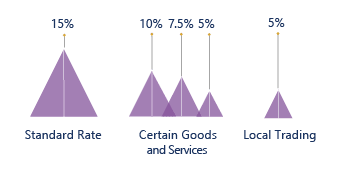
VAT is levied on the supply of goods and the provisions of services, and on the import of goods and services. Supplies of goods and services without consideration are valued at their fair market price.

Registration
Filing and Payment
OECD type transfer pricing provisions apply. The definition of “associated enterprise” extends beyond a shareholding or management relationship, as it includes some deeming clauses.
Every person/company who has entered into an international transaction shall furnish a statement of international transactions in the prescribed form along with their annual income tax return.
A taxpayer that engages in cross-border transactions exceeding BDT 30 million is required to maintain documentation and to provide a certificate (in a prescribed format) from a chartered accountant that sets out the details of related party transactions, as well as the methods used to determine an arm’s length price, provided a notice for filing the certificate is received from the tax authorities.

Bangladesh Labour Law 2006 (Amended 2013) and Bangladesh Labour Rules 2015 are the prevailing labour relation regulations currently. However, the Labour Law 2006 is mainly used to govern the relationship between employers and workers. Workers are defined in the law as:
Considering this, there is ambiguity on whether management staff and employees in the service sector fall under this Act or that relationship can be simply governed through employment contracts. This area is being reviewed by the Bangladesh Courts and a new law is expected soon.
ResidencyIn Bangladesh an individual is treated as a resident if they have been in Bangladesh for:
Short term visitors and dependents of expatriates not earning any income in Bangladesh are
not taxable locally and do not have to file a tax return. Nationality has no impact on taxability.
Taxpayer’s Identification Number (e-TIN)
All individual taxpayers are required to obtain an e-TIN in order to file a tax return. This is
relatively easy and can be obtained from http://secure.incometax.gov.bd/TINHome.
Deadline for Tax Return Filing
The last date for filing tax returns is 30 November following the end of the income year which
is now termed Tax Day.
Employers are responsible for deducting taxes at source after providing for allowances from
monthly salary. However, all employees are responsible for filing of their own returns at the
end of the tax year. If, however, an individual has other sources of income such as house rent,
interest income etc., he/she is responsible for filing accordingly and paying taxes at the time
of filing. Income from salary includes the following:
Individuals enjoying salary income are subject to tax on salary and all other benefits. A
summary of taxability and allowances are as below:
| Income Head | Taxability |
|---|---|
| Basic Salary | Fully taxed |
| House Rent Allowance (in cash/with salary) | Tk. 25,000 per month or 50% of basic salary, whichever is lower is exempt from tax. |
| Rent free accommodation | Actual rent paid by employer or 25% of basic salary, whichever is lower shall be added to total income and taxed. |
| Conveyance Allowance (in cash/with salary) | Tk. 30,000 per annum is exempt from tax where no conveyance facility is provided by employer. |
| Conveyance provided for personal/private use | If employer provides conveyance for personal or private use, 5% of the employee’s basic salary or Tk. 60,000 whichever is higher, is added to total income and taxed. |
| Medical Expenses | Tk. 120,000 per annum or 10% of basic salary, whichever is lower is exempt from tax. |
Medical expenses up to Tk. 1,000,000 paid to a disabled | |
Medical expenses paid to an employee (other than a | |
| Travel (local & foreign) | Amounts paid at actual against bills/receipts are tax free. Any benefit paid in addition in cash is taxable. |
| Festival Bonus | Fully taxable |
| Performance Bonus | Fully taxable |
| Utility expenses | Fully taxable |
| Telephone/Mobile allowance | Tax free as long as it is for official use. |
| Entertainment allowance | Fully taxable |
| Other allowances | Fully taxable |
| Any reimbursements | Tax free as long as it was incurred for official purposes. |
Employers usually deduct taxes at source after providing for allowances from monthly salary. However, all employees are responsible for filing of their own returns at the end of the tax year. If, however, an individual has other sources of income such as house rent, interest income etc., he/she is responsible for filing accordingly and paying taxes at the time of filing.
Income tax is charged to individuals on fixed slabs. The slabs of total income and
corresponding tax rates are given below:
| Amount of Taxable Income | Rate |
|---|---|
| First Tk. 300,000 | Nil |
| First Tk. 350,000 (in case of female, senior taxpayers over the age of 65 and people of third gender) | Nil |
| First Tk. 450,000 (in case of disabled taxpayers) | Nil |
| First Tk. 475,000 (in case of Gazetted War-Founded Freedom Fighter Taxpayer) | Nil |
| Tk. 50,000 above their applicable total income floor (in case of any one parent/legal guardian of Disabled Individuals) | Nil |
| On the next Tk. 100,000 | 5% |
| On the next Tk. 300,000 | 10% |
| On the next Tk. 400,000 | 15% |
| On the next Tk. 500,000 | 20% |
| On the balance | 25% |
| The tax rate for non-residents | Flat 30% |
Work permit is mandatory for every foreign national seeking employment in Bangladesh. Three
government authorities issue work permit in Bangladesh.
Social Security System
Bangladesh does not have a mandatory social security system for private sector employees and employers are not required to setup or deduct any social security contributions.